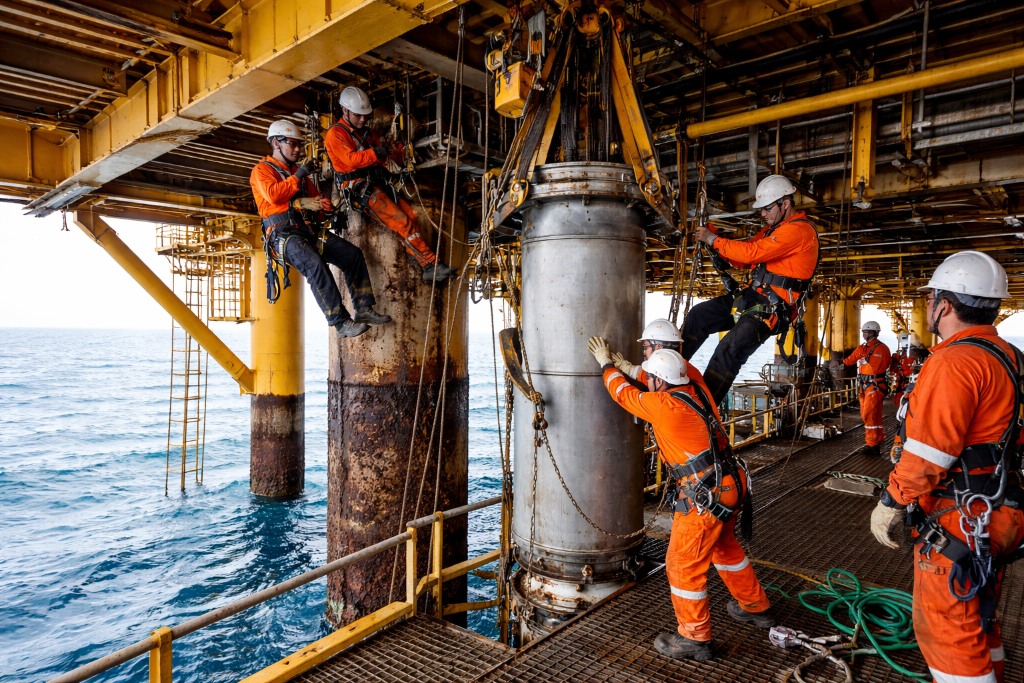
The Hidden Weak Point in Offshore Platforms: Caisson Integrity Management
7–8 minute read · HPG Engineering
Offshore platforms are complex structural systems designed to operate reliably in some of the harshest environments on earth. Jackets, decks, bridges, flare booms, and processing modules often receive significant engineering attention during design, inspection, and life-extension assessments. Yet one critical component of offshore infrastructure is frequently underestimated: the caisson.
Caissons are vertical tubular structures attached to offshore platforms, typically used for seawater lift systems, firewater supply, pump intakes, and utility discharge systems. Despite their importance to platform operations and safety systems, caissons often operate in highly aggressive environments where corrosion and degradation can progress rapidly if not properly monitored.
Because caissons are partly submerged and partly exposed to the marine splash zone, they are subject to some of the most severe corrosion conditions in offshore environments. Without structured integrity management, they can become one of the most vulnerable components of offshore infrastructure.
Understanding the risks associated with caisson degradation—and how they can be managed—is essential for maintaining the reliability and safety of offshore installations.
The Role of Caissons in Offshore Platforms
Caissons serve several essential operational functions on offshore installations. One of the most common applications is seawater lift, where caissons house pumps that draw seawater from below the platform for use in cooling systems, firewater systems, and other process utilities.
In many installations, caissons extend several metres below the platform deck and are fixed directly to the jacket or structural framing. Their vertical orientation allows them to access stable seawater levels even in varying tidal conditions.
Because seawater systems are often critical for cooling, firefighting, and process operations, the reliability of caisson structures is directly linked to the safe operation of the platform.
However, the same environment that makes caissons useful also exposes them to intense corrosion risk.
Splash Zone Corrosion: The Most Aggressive Environment Offshore
One of the most severe degradation mechanisms affecting caissons occurs in the splash zone. The splash zone is the region of the structure that is intermittently exposed to seawater, waves, oxygen, and drying cycles. This environment creates ideal conditions for accelerated corrosion because it combines continuous wetting and drying, high oxygen availability, mechanical abrasion from waves and debris, and salt deposition.
Steel structures in the splash zone often corrode significantly faster than those fully submerged below the waterline. Protective coatings in this region may degrade quickly due to wave impact and ultraviolet exposure, leaving the steel surface exposed to aggressive corrosion.
Over time, this can result in significant wall thickness loss, particularly if inspection and maintenance programs do not adequately monitor splash-zone areas. Because caissons pass directly through this zone, they are particularly susceptible to this type of degradation.
Internal Corrosion in Seawater Lift Caissons
While external corrosion receives significant attention, internal corrosion inside seawater lift caissons is often one of the most critical but least visible integrity threats. Seawater lift pumps installed within caissons create a dynamic internal environment that can accelerate degradation mechanisms.
Seawater lift pumps generate high-velocity flow and turbulence within the caisson. This turbulence can remove protective oxide layers on the internal steel surface and expose fresh metal to seawater. Near pump intakes and discharge zones, erosion-corrosion may occur where mechanical wear and electrochemical corrosion act simultaneously. Over time this may lead to localized wall thinning.
The interaction between the pump and the caisson wall can also create recirculation zones and turbulent flow patterns, particularly if the clearance between the pump and the caisson wall is insufficient. These conditions can accelerate internal corrosion and erosion near the pump intake region.
If pumps operate outside optimal hydraulic conditions, cavitation may occur. Cavitation bubbles collapsing near the internal steel surface can cause localized pitting damage and accelerate corrosion. In areas of low flow or localized stagnation within caissons, microbiologically influenced corrosion (MIC) may also develop, leading to aggressive pitting corrosion.
Marine Growth and Hydrodynamic Loading
Marine growth presents another challenge for caisson integrity management. Over time, offshore structures accumulate biological growth such as barnacles, algae, and shell organisms. On vertical members such as caissons, this growth can significantly increase the effective diameter of the structure.
This has two important structural implications. First, it increases hydrodynamic loading on the structure during wave action. The larger effective surface area increases drag forces acting on the caisson and its supporting connections. Second, marine growth can obscure structural surfaces, making visual inspection more difficult and allowing corrosion to progress unnoticed beneath the biological layer.
Effective inspection programs must therefore consider both marine growth removal and accurate assessment of the underlying steel surface.
Structural Consequences of Caisson Degradation
If corrosion significantly reduces the wall thickness of a caisson, its structural capacity may be compromised. Caissons must resist several types of loading, including self-weight and equipment loads, hydrodynamic forces from waves and currents, vibration from pumping equipment, and impact forces from floating debris.
If corrosion reduces the structural section below acceptable limits, the caisson may begin to deform, vibrate excessively, or develop cracking at welded connections. In severe cases, structural failure may occur at the interface between the caisson and the supporting platform structure. Because seawater systems are often critical to platform operation — particularly firewater systems — such failures can have significant operational and safety implications.
Inspection Techniques for Caisson Integrity
Due to their location and operating environment, caissons require specialized inspection approaches addressing both external marine exposure and internal degradation mechanisms associated with seawater lift systems.
Divers or remotely operated vehicles (ROVs) inspect external surfaces for corrosion, coating degradation, marine growth, and structural damage. Particular focus is given to the splash zone, where corrosion rates are typically highest. Ultrasonic thickness measurements are taken along the caisson length to identify wall thinning due to corrosion or erosion, and repeat measurements over time allow corrosion progression to be monitored.
Internal inspection of seawater lift caissons often requires mechanical or high-pressure cleaning prior to inspection. Marine growth, debris, and corrosion products may accumulate internally and obscure the steel surface. In areas where corrosion may be irregular or severe, UT C-scan mapping can be deployed, producing a two-dimensional thickness map of the steel surface and allowing engineers to visualize corrosion patterns and quantify localized wall loss.
Design Improvements to Reduce Caisson Integrity Risks
While inspection and maintenance are essential, many in-service caisson problems originate from design limitations. Incorporating integrity considerations during design can significantly reduce long-term degradation risks.
Where caissons are electrically connected to the platform structure, cathodic protection (CP) systems can be designed to extend protection to submerged sections. High-performance marine coatings or specialized splash-zone protection systems can significantly reduce corrosion rates when properly specified and maintained.
Design wall thickness should incorporate appropriate corrosion allowance, particularly for splash-zone regions and pump intake zones. For pump caissons, ensuring a suitable annular gap between the pump assembly and the caisson wall is critical — insufficient clearance can create severe turbulence, recirculation zones, and localized erosion-corrosion.
Designing caissons with inspection access provisions, removable pump assemblies, and defined inspection zones can significantly improve long-term inspectability and maintenance effectiveness.
Managing Caisson Integrity Through Structured SIM Programs
Effective caisson integrity management should be integrated into the broader Structural Integrity Management (SIM) framework. Within a SIM program, caisson inspection data is systematically recorded, assessed, and linked to maintenance planning processes. Risk-based inspection methodologies allow operators to prioritize caisson inspection intervals based on degradation history, environmental exposure, and operational criticality.
Digital inspection systems and asset management platforms increasingly improve visibility of caisson condition across offshore asset portfolios. When integrated with maintenance systems, these tools allow operators to track anomalies, monitor corrosion progression, and plan repair or replacement strategies proactively. For ageing offshore installations, caisson integrity management often becomes a key component of asset life-extension programs.
Strengthening One of Offshore Engineering's Most Overlooked Assets
Offshore platforms are often evaluated primarily based on the condition of their primary structural systems. Yet secondary components such as caissons can present equally significant risks if not properly maintained. Because caissons operate in extremely aggressive marine environments and often support critical operational systems, their integrity deserves careful engineering attention.
Through good design practices, structured inspection programs, and proactive integrity management, operators can significantly reduce the risk of caisson failure and extend the service life of offshore infrastructure. Ensuring their integrity is therefore essential for maintaining safe and reliable offshore operations.