Beyond Power and Cooling: The Role of Asset Infrastructure in Data Centre Reliability
10 minute read · HPG Engineering
Data centres are widely regarded as some of the most advanced and resilient engineered environments in operation today. Their reliability is typically associated with electrical redundancy, backup power systems, and sophisticated cooling infrastructure designed to support continuous operation.
However, recent incidents and operational experience have highlighted an important reality: data centre failures are not always driven solely by electrical or IT-related issues. In many cases, the underlying causes — or the severity of the consequences — are linked to the physical asset infrastructure that supports these systems.
Asset infrastructure, including equipment supports, cable management systems, anchorage arrangements, and structural elements, forms the foundation upon which all critical systems operate. When these elements are not adequately assessed, maintained, or integrated, they can become a hidden source of risk.
Lessons from Real-World Failures
While not always publicly detailed in engineering terms, several well-known incidents illustrate how failures in physical infrastructure can contribute to major disruptions.
The 2021 fire at OVHcloud in Strasbourg resulted in the complete loss of a data centre facility. While the initiating event is widely understood to have originated within electrical power systems — particularly UPS and inverter equipment — the exact ignition source was never conclusively determined.
Investigations indicated that failures within supporting systems, including potential moisture interaction with electrical equipment, may have contributed to the incident. Critically, the rapid propagation of the fire was influenced by infrastructure factors such as material selection, compartmentalisation, and building configuration.
The presence of combustible construction elements and ventilation pathways that facilitated vertical fire spread demonstrated how engineering and architectural decisions within asset infrastructure can significantly influence the severity of such events.
Similarly, outages within Amazon Web Services facilities have demonstrated how failures in supporting systems can cascade into widespread service disruption. Although often attributed to power or network issues, these events typically involve interconnected infrastructure where mechanical, electrical, and asset infrastructure systems are closely linked.
Flooding incidents affecting data centres globally have also shown how physical layout, equipment elevation, and infrastructure planning can determine whether facilities remain operational or experience critical failure.
These examples reinforce a key point: reliability is not just a function of electrical design, but of the entire engineered system.
The Overlooked Role of Asset Infrastructure
Data centres rely on a complex network of asset infrastructure systems that are often considered secondary to electrical and IT components. In reality, they are fundamental to safe and reliable operation.
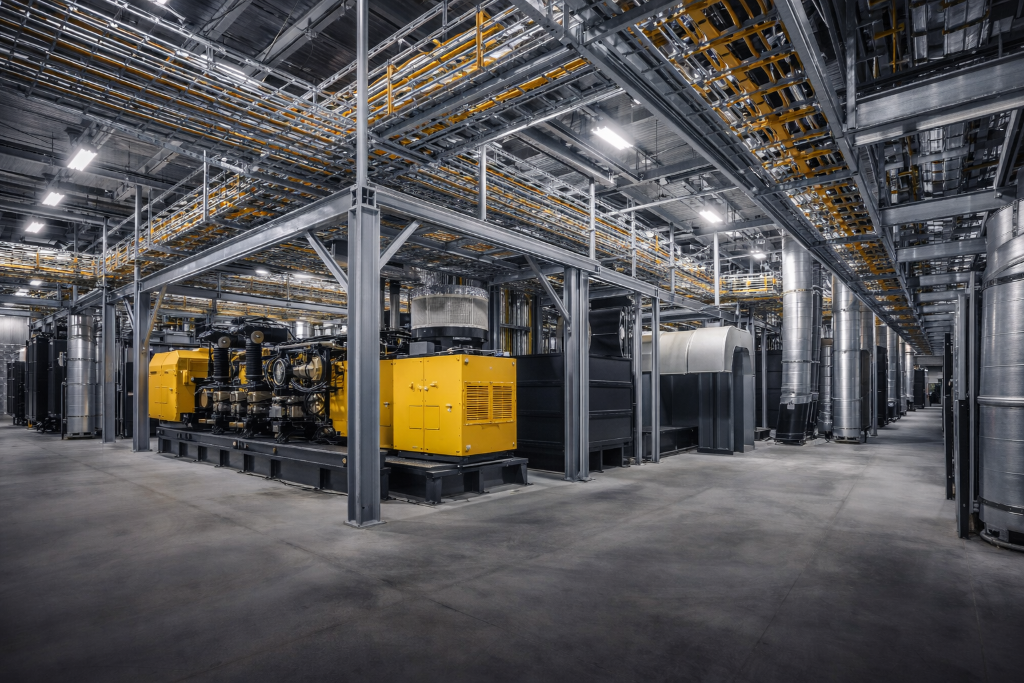
Key elements include: steel frames and mezzanine structures supporting equipment and access systems; generator and UPS support structures subjected to high static and dynamic loads; cable tray and pipe support systems carrying critical power and cooling services; anchorage systems and fixings ensuring stability of equipment under operational conditions; external and rooftop structures supporting plant and ancillary systems.
Failure or degradation in any of these elements can compromise equipment performance, create safety risks, and ultimately lead to downtime.
Common Failure Mechanisms in Data Centres
Drawing on experience from offshore and industrial sectors, several failure mechanisms are directly applicable to data centre environments.
Overloading and Capacity Exceedance
Data centres are frequently upgraded to accommodate increasing demand. This often involves installing additional or heavier equipment on existing structures. Without proper reassessment of asset infrastructure, this can lead to overstressed beams or supports, excessive deflection, and localised failure of structural elements.
Vibration and Fatigue
Rotating equipment such as generators, pumps, and cooling systems introduce cyclic loading into support systems. Over time, this can result in fatigue cracking in welded or bolted connections, loosening of fixings, and progressive degradation of asset infrastructure. These effects are well understood in offshore structures but are often underappreciated in data centre environments.
Anchorage and Fixing Failures
Equipment stability depends heavily on anchorage systems. Poor installation, inadequate design, or long-term degradation can lead to reduced load capacity, movement under operational loads, and increased stress on connected systems.
Corrosion and Environmental Degradation
While data centres are typically controlled environments, certain areas — particularly external structures, plant rooms, and coastal facilities — remain susceptible to corrosion. If not properly managed, corrosion can reduce structural capacity and compromise long-term performance of asset infrastructure.
Integration of New Infrastructure
Brownfield modifications present a significant risk if not properly engineered. The integration of new systems into existing infrastructure can introduce unintended load paths, local overstressing, and incompatibility between old and new systems.
Supporting Systems and Failure Propagation
Data centre incidents are rarely the result of a single isolated failure. In many cases, supporting systems — including cooling infrastructure, ventilation systems, and building configuration — play a critical role in both initiating and amplifying failure events.
Failures in cooling systems, such as mechanical faults in fans, motors, or cooling towers, have been identified as potential ignition sources in certain facilities. Similarly, water leaks from cooling or pipework systems can interact with electrical infrastructure, increasing the likelihood of short circuits and equipment failure.
Ventilation paths, cable voids, and structural layouts can further influence how fire, heat, or smoke propagates through a facility. Where compartmentalisation is inadequate, localised failures can escalate rapidly into facility-wide incidents.
These interactions highlight the importance of considering data centres as integrated engineered systems, where structural, mechanical, electrical, and asset infrastructure elements must be assessed collectively rather than in isolation.
Material and Structural Resilience
The selection of construction materials and the configuration of structural systems can significantly influence how failures develop and propagate within a data centre environment. Material behaviour under extreme conditions — including fire, heat exposure, and mechanical loading — plays a critical role in determining the extent of damage and the ability of a facility to maintain structural stability.
In high-density, mission-critical environments, appropriate material selection, fire resilience, and structural compartmentalisation should be considered as part of a holistic engineering approach to asset infrastructure reliability.
Why This Matters for Data Centre Operators
Failures in asset infrastructure systems may not always be immediately visible, but their consequences can be significant. These include equipment instability or malfunction, increased maintenance requirements, safety risks to personnel, and unplanned outages and downtime. In mission-critical environments where uptime is paramount, even minor issues can have disproportionate impacts.
Applying Asset Integrity Management to Data Centres
The offshore and industrial sectors have long recognised the importance of managing asset integrity throughout the lifecycle of an asset. These same principles can be applied effectively to data centre infrastructure.
A structured approach includes: reassessment of asset infrastructure to verify capacity and performance under current and future loads; Risk-Based Inspection (RBI) to prioritise inspection activities based on criticality and risk; inspection planning and execution to identify degradation before it leads to failure; lifecycle management to support long-term operation and upgrades; integration with digital systems to improve data-driven decision-making.
By adopting these practices, data centre operators can move from reactive maintenance to proactive risk management.
Inspection and Condition Assessment of Asset Infrastructure
A key component of effective integrity management in data centres is the implementation of targeted inspection and condition assessment programmes. These must be designed to operate within live environments, minimising disruption while ensuring that critical infrastructure is adequately assessed.
Typical inspection approaches include routine visual inspection of structural elements, equipment supports, cable trays, and anchorage systems; borescope and remote visual inspection of inaccessible areas; anchorage and fixing assessment; vibration and condition monitoring where rotating equipment is present; and corrosion and degradation assessment for external plant areas and coastal environments.
Inspection activities should be prioritised based on risk, focusing on critical equipment supports, high-load structural elements, areas with known degradation mechanisms, and components subject to modification or upgrade. This ensures inspection effort is directed where it delivers the greatest value in maintaining reliability and reducing unplanned downtime.
Conclusion
As data centres continue to grow in scale and complexity, ensuring the reliability of asset infrastructure becomes increasingly important. While electrical and IT systems remain critical, they are ultimately supported by physical systems that must be equally robust, well-maintained, and properly understood.
Recognising the role of asset infrastructure in data centre performance allows operators to identify hidden risks, improve resilience, and support the long-term reliability of mission-critical infrastructure.
Asset infrastructure integrity is not just an engineering consideration — it is a key enabler of data centre reliability.